

Blog Post
Synergies Between Digestates and Biochars for Soil Improvement
Introduction
Soils are essential for life on Earth, providing the foundation for food production, water filtration, and carbon storage. However, they face numerous challenges such as erosion, nutrient depletion, pollution, and loss of organic matter. These issues lead to reduced agricultural productivity, increased greenhouse gas emissions, and compromised ecosystem health. To learn more about the importance of healthy soils and the challenges they face, please visit us: https://project-fenix.eu/why-do-soils-need-help/.
The use of biochars, a carbon-rich material produced through the pyrolysis of organic biomass, and digestates, by-products of anaerobic digestion process, offers a promising approach to sustainable soil management.
Biochar retains essential nutrients, making them more available to plants. It enhances soil structure by increasing porosity and water retention, which supports better root growth. Additionally, biochar provides a habitat for beneficial soil microorganisms, boosting microbial activity. It also sequesters carbon in the soil, helping to mitigate climate change, and can adsorb pollutants, reducing their bioavailability and toxicity.
Meanwhile, digestates are rich in essential nutrients like nitrogen, phosphorus, and potassium, which are crucial for plant growth. Digestates add organic matter to the soil, improving soil aggregation and stability. They also provide food for soil microorganisms, enhancing microbial activity and diversity and contribute to soil organic carbon.
Why combine them?
Combining biochar and digestates offers several benefits for soil improvement by enhancing key properties:
- Soil pH: Biochar raises soil pH, making it more alkaline—beneficial for acidic soils—while digestates help balance pH and improve nutrient availability.
- Cation exchange capacity (CEC): Biochar’s high CEC enhances nutrient retention, while digestates contribute organic matter, further improving nutrient availability for plants.
- Porosity & Structure: Biochar increases soil porosity, improving water retention and aeration, while digestates promote soil aggregation, enhancing overall structure.
- Mineralization rates are optimized as digestates provide readily available nutrients that can be quickly mineralized and used by plants, while biochar slows down the mineralization process, ensuring a steady release of nutrients over time, providing both immediate and long-term nutrient availability.
- Carbon sequestration is significantly enhanced as biochar is stable and can sequester carbon in the soil for long periods, helping mitigate climate change, and digestates add organic carbon to the soil, although they decompose faster than biochar, enhancing overall carbon sequestration and soil organic carbon content.
This synergy enhances soil fertility, structure, and microbial activity, contributing to sustainable soil management and environmental resilience.
How do we implement this in the FENIX project?
The FENIX project has made significant progress in several areas:
- Biochar Production: The project has successfully produced 36 different types of biochar at lab scale using various pyrolysis conditions. These biochars have been characterized and the best four types have been selected for further research and application.
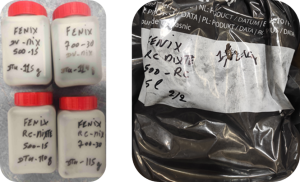
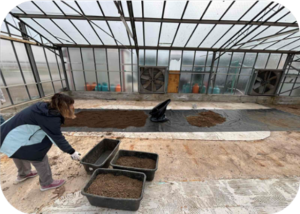
- Greenhouse and Laboratory Experiments: Greenhouse pot experiments have been set up to test the effects of biochar-digestate mixtures on different soil types. These experiments aim to evaluate soil quality, nutrient retention, and microbial activity.
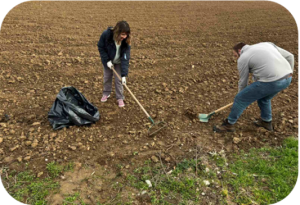
- Field Trials: Initial soil characterization has been completed for experimental plots in Spain, Greece, and France. These plots will be used for field trials to test the effectiveness of biochar-digestate mixtures on various soil types and crops.
- Regulatory Compliance: The project has reviewed the regulatory compliance of the raw materials used to formulate the soil improvement products. This includes evaluating the conformity of biochar and digestates with European regulations.
In the coming months, the project partners will focus on the following steps:
- Calibration and Large-Scale Production: Calibration of the pyrolysis system at the pilot scale is planned to replicate lab-scale biochar production parameters. Large-scale production of biochar will follow, using the selected types and conditions.
- Field Application: Biochar-digestate mixtures will be applied to the experimental plots in Spain, Greece, and France. The effectiveness of these mixtures will be monitored over time, focusing on soil physical, chemical, and biological properties.
- Advanced Laboratory Tests: Further laboratory tests will be conducted to optimize biochar-digestate mixtures for different soil types. This includes testing different concentrations and metal ion coatings to enhance anaerobic digestion efficiency.
- Business Model Development: The project will develop a business model and plan for the commercialization of the soil improvement products. This includes identifying market outlets and marketing strategies.
- Impact Monitoring: The project will continue to monitor and quantify the environmental and socio-economic impacts of the soil improvement products. This includes assessing nutrient recovery, carbon sequestration, and greenhouse gas emissions.
These steps will ensure the successful implementation and commercialization of the FENIX project’s soil improvement products, contributing to sustainable agriculture and environmental sustainability.
Conclusion / Main ideas
The synergy between biochar and digestates offers a powerful solution for soil enhancement by improving pH balance, nutrient retention, soil structure, and carbon sequestration. Biochar provides long-term stability and aeration, while digestates supply readily available nutrients and organic matter, ensuring both immediate and sustained soil fertility.
Within the FENIX project, these benefits are being tested and optimized through lab-scale biochar production, greenhouse pot experiments, and field trials across Spain, Greece, and France. The project aims to refine biochar-digestate formulations, monitor environmental impacts, and develop a commercialization strategy, contributing to sustainable agriculture and climate change mitigation.
By: E. Knipping
Editorial: L. Salinas
March 2025

