

Blog Post
Biochar for soil improvement
Tracing biochar’s roots
Did you know that the concept of biochar dates back to indigenous times in the Amazonia, where it was discovered that the dark, fertile soils known as Terra Preta contained large quantities of charcoal (J.Lehmann, 2003)?
Unlike typical Amazonian soils, which are nutrient-poor due to their acidity, Terra Preta is fertile and capable of retaining nutrients and water, making it exceptionally productive. The formation of Terra Preta is attributed to , which included the controlled biomass burning and incorporating organic matter and waste, such as bones, animal manure, and pottery fragments (Sebastian Alegre, 2024). This process enriched the soil with charcoal, also known as biochar, and improved its structure, which promoted the proliferation of beneficial microorganisms.
While rooted in ancient practices, the term biochar and its systematic study by the scientists and environmentalists began to gain attention in the early 2000s, focusing on its applications in modern agriculture.
This blog, part of the FENIX project, explores the biochar’s benefits as a soil amendment for agricultural soils and its environmental implications. FENIX aims to develop a soil improvement product combining biochar and digestates (to be introduced in our next blog post) that improves soil fertility, water-holding capacity, nutrient uptake and microbial activity, while also providing economic benefits to agriculture.

What is biochar and how is it obtained?
Production processes
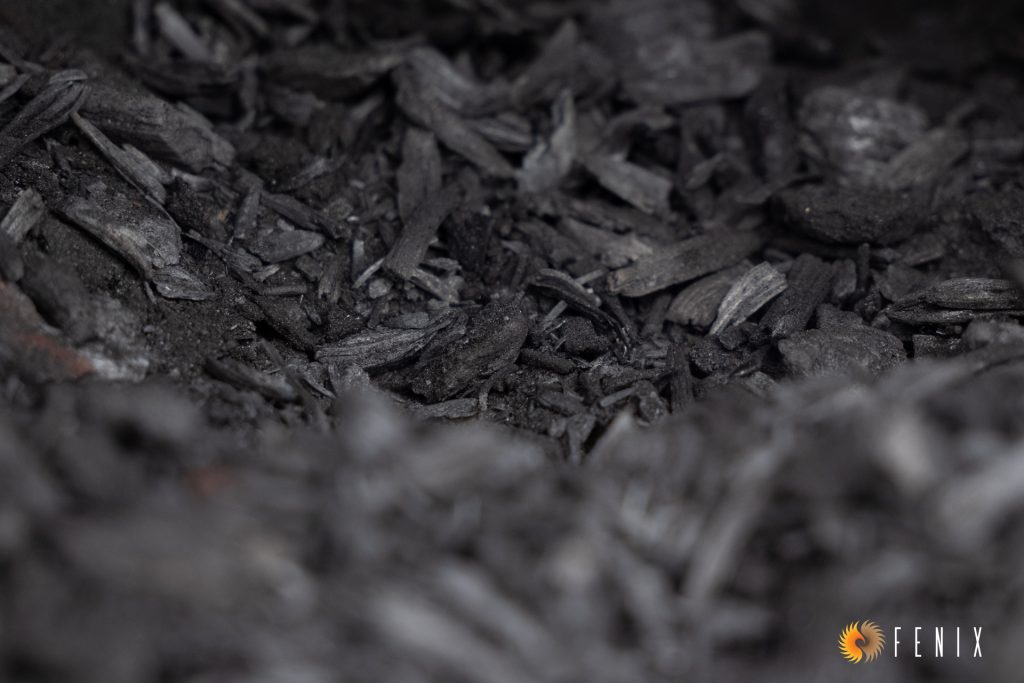
Biochar is a solid form of charcoal; therefore, it is a carbon-rich compound, produced through a thermochemical process known as pyrolysis. This process occurs at temperatures between 300-700ºC and involves the thermal decomposition of organic waste such as agricultural residues, wood chips, or crop waste in a low-oxygen environment. Even though charcoal from woody feedstock is the most common and best-known type of biochar, all biogenic materials can, in principle, be converted into biochar.
This process not only produces biochar but also yields bio-oil, with a high potential for obtaining renewable chemicals, and syngas for the production of methane. Depending on the type of product targeted, there are two main types of pyrolysis distinguished by their heating rates:
- Slow pyrolysis (300-500°C) results in minimal syngas and bio-oil production but produces a significant amount of biochar.
- Fast pyrolysis (600-800ºC) generates substantial amounts of syngas and bio-oil but produces less biochar presenting slightly different properties compared to that produced by slow pyrolysis.
Applications of biochar
Biochar can be used in a variety of applications, ranging from heat and power production, flue gas cleaning, metallurgical applications, use in agriculture as a soil amendment, carbon sequestration when applied to soil, building material, to medical use. However, the composition of biochar is an important indicator to determine its application. The physical and chemical properties of the biochar are very important in defining the final application of this bio-based product. The FENIX project will focus on the production of biochar targeted for soil improvement.
Benefits of biochar in soil management and environmental impact
Biochar, when produced with optimal properties, is a valuable product known for enhancing soil quality and sequestering carbon. This stable, carbon-rich material retains the organic structure of the original biomass, making it a powerful tool in combating climate change and promoting agricultural sustainability.
To improve agricultural soils, the aim is to obtain a biochar with high porosity, large surface area and the right chemical composition that makes it ideal for use in degraded agricultural soils. Mostly, the quality of biochar is largely determined by its fixed carbon content, which refers to the stable, solid carbon that remains after production. This solid carbon remains crucial for long-term carbon storage in soil. Additionally, the pH-value of biochar is an important property for agricultural applications such as soil amendment.
Environmental benefits
Overall, these qualities make biochar highly beneficial for agricultural soils, offering significant advantages for soil management and improving environmental sustainability. It improves soil structure, increasing water retention and reducing erosion. When combined with digestates, biochar can boost plant production and stimulate microbial activity. It also helps regulate the pH of highly acidic soils and enhances their physical and chemical properties.
Moreover, biochar plays a crucial role in carbon sequestration, capturing carbon and storing it in the soil for centuries, which helps mitigate climate change. It also reduces methane emissions from soil and enhances nutrient retention, reducing the need for chemical fertilizers. Additionally, biochar provides a habitat for beneficial soil microbes, which are essential for nutrient cycling.
Fun fact: Laboratory experiments suggest that biochar can remain stable in soil for hundreds to thousands of years, as only a small fraction degrades over time, although it is challenging to predict its long-term behaviour.
Sustainability and circular economy
Producing biochar from bio-waste as a feedstock aligns with circular economy principles and the EU Green Deal by contributing to waste reduction and energy production. This process transforms organic waste into a valuable resource, closing the loop in material cycles and promoting sustainable waste management practices. By utilizing bio-waste in this way, biochar production enhances resource efficiency and reduces the environmental footprint associated with waste disposal.
Biochar challenges and FENIX solutions
Despite its advantages, the use of biochar is still not widespread—the optimal application of biochar in soil has yet to be fully demonstrated. Hence, further research is essential to address several key questions:
- How biochar can directly affect soil organic carbon dynamics.
- Its impact on enhancing soil fertility.
- The risk of plant productivity decreases after biochar application, possibly due to nutrients immobilization and reduced carbon mineralization.
- Its capacity for carbon capture and storage.
- Its effect on different soil types.
Thus, further studies are needed to understand in depth the production processes and the short- and long-term effects of biochar on crop growth and soil health.
To do so, the FENIX project will utilize the pyrolysis conversion process to produce biochar from green waste, including garden and park pruning waste collected from urban areas. The project plans to conduct laboratory and field tests across Europe to enhance our understanding and provide practical demonstrations. The consortium will identify the most effective types of biochar, combine them with digestates, and evaluate the best formulations for different soil types. Tests on five different crops across Europe will assess biochar's impact on soil fertility, water retention, and its role in mitigating land desertification caused by climate change.
Through rigorous testing and research, the FENIX Project aims to fully realize the benefits of biochar for sustainable soil management.
For more information on digestates, look out for our upcoming post on the topic.
References:
J.Lehmann, e. a. (2003). Historical ecology and future explorations. In Amazonian Dark Earths: Origin Properties Management (pp. 455-500). Springer Netherlands.
Sebastian Alegre. (March de 2024). Terra Preta: La mejor tierra para la biodiversidad que hacían los pueblos indígenas sin siquiera pensarlo. Obtenido de https://sebastianalegre.com/sostenibilidad-medio-ambiente/terra-preta-biodiversidad-pueblos-indigenas/
By: J. Gómez, M. Romero
Editorial: L. Salinas
September 2024

